
You see it everywhere online. Someone posts “major FOMO rn” and everyone gets it. But what is the real FOMO meaning in text? Let’s clear it up in simple words. This guide will make FOMO meaning in text easy for you.
FOMO stands for “Fear Of Missing Out.” It is that tight feeling when others have fun without you. You see their photos and wonder why you are not there. People now type it in chats, captions, and comments. That is the everyday FOMO meaning in text in 2026.
Why does this slang matter so much today? Social media shows everyone’s best moments all day long. That makes us feel left out more often. Knowing the FOMO meaning in text helps you reply with the right tone. Let’s look at how people really use it, step by step.
Meaning & Definition FOMO Meaning in Text
What does FOMO stand for? It stands for Fear of Missing Out. It describes the worry that other people are enjoying something valuable while you sit it out.
Here’s the FOMO definition in one line: it’s a social feeling, not a physical fear. You’re not scared of an object. You’re uneasy about being absent from a fun, popular, or important moment.
The FOMO meaning in text works the same way in every chat app. Whether it’s a quick “FOMO 😭” or a long caption, the message says “I wish I were there.” That’s the FOMO meaning in English for everyday use.
FOMO Meaning in Text Slang
As FOMO slang, the word works like a mood label. It’s short and emotional. People drop it into a sentence without explaining it.
The FOMO meaning in text slang is flexible. It can be sincere, joking, or dramatic. Tone and context decide which one you’re reading.
Common slang forms include:
- “I have FOMO” means I feel left out right now.
- “FOMO is real” means this feeling is strong and relatable.
- “Major FOMO” means the feeling is intense.
- “FOMO hit me” means it came on suddenly.
- “No FOMO here” means I’m fine missing it.
FOMO Meaning in Text Urban Dictionary
Urban Dictionary entries usually describe FOMO as anxiety about missing a party, trend, or social event. Most entries are casual and a bit humorous. They match how people actually text.
The FOMO meaning in text urban dictionary style is a good snapshot of real usage. Still, treat user-written definitions as slang notes, not official sources. Check them against a trusted dictionary when accuracy matters.
Why Does FOMO Happen?
FOMO happens when you compare your life with what others seem to be doing. Social feeds make it worse because they show the highlights nonstop. You scroll, and suddenly everyone looks busier than you.
There’s also a basic human need behind it. We want to belong. When you think a group is bonding without you, your brain treats it like a small threat.
Common triggers include:
- Seeing Instagram Stories from an event you skipped
- Reading a group chat full of inside jokes you missed
- Watching a viral trend blow up before you try it
- Hearing coworkers discuss a meeting you weren’t invited to
- Spotting a limited-time offer counting down
FOMO as a Noun
FOMO is mostly used as a noun. You have FOMO, get FOMO, or feel FOMO. It names the feeling itself.
People also use it as a modifier. “FOMO purchase” and “FOMO trip” are common. In both, the decision came from not wanting to miss out.
A few sentences show it clearly:
- “My FOMO made me buy the ticket.”
- “That’s a total FOMO move.”
- “She’s got FOMO about the reunion.”
FOMO Can Be Positive or Negative
Most of the time, FOMO feels negative. It brings worry, restlessness, or a sinking feeling. That’s why people say “FOMO” with a groan.
But it can also push you to act. Maybe you almost skipped a friend’s wedding, then FOMO nudged you to go. You made a great memory, so the outcome was good.
So the FOMO meaning in text isn’t always bad. The feeling is uncomfortable, but the result depends on what you do with it. Joining a fun event is healthy. Overspending to keep up isn’t.
Background FOMO Meaning in Text
The feeling is old, but the word is fairly new. People have always worried about missing parties, deals, and news. Social media just gave the feeling a spotlight and a catchy name.
Before smartphones, you only knew about events if someone told you. Now you can see them live. That visibility is why the FOMO meaning in text feels so current in digital culture.
Here’s a quick timeline of how it grew:
- Early social networks made friends’ plans visible.
- Photo apps turned daily life into a public highlight reel.
- Stories and short videos made missing out feel instant.
- Group chats made exclusion easier to notice.
- Today, FOMO in modern communication shows up in almost every platform.
FOMO and Social Comparison
Social comparison is the heart of FOMO. You measure your weekend against someone else’s post. Of course, you only see their best five minutes.
That’s the trap. A friend’s beach photo hides the sunburn, the traffic, and the awkward dinner. Your brain forgets those details and compares your normal day to their highlight.
Try this simple reality check:
- Ask what the post leaves out.
- Remember that people post wins, not boredom.
- Compare your week to your own goals, not their feed.
Why the Abbreviation Is Convenient
Texting rewards speed. Typing “I’m afraid I’m missing out on something fun” takes effort. “FOMO” takes one second.
It’s also emotionally efficient. Four letters carry worry, humor, and longing together. That’s why this texting abbreviation spread so fast and stuck around in the FOMO meaning in text conversation.
Usage in Different Contexts
FOMO changes slightly depending on where you see it. The meaning stays the same, but the weight shifts. A joke in a group chat reads differently from a line in a marketing email.
Think of it like the word “tired.” You can say it about a long day or about a deeper problem. The FOMO meaning in text always needs a little context.
Chat, Social Media, and Professional Fields
In casual chat, FOMO is light. A friend might text, “Dinner without me? FOMO!” It’s playful and quick.
On social media, it shows up in comments and captions. “This festival looks unreal. Major FOMO.” Professionals use it too, mostly in marketing, product talks, and informal workplace chats.
Examples by setting:
- Chat: “You guys are at the arcade? FOMO!”
- Social media: “Your trip photos gave me serious FOMO.”
- Work: “Everyone’s attending the webinar, so I’m joining to avoid FOMO.”
FOMO in Marketing
Marketers use FOMO on purpose. They know people act faster when an opportunity feels scarce. That’s basic consumer behavior.
You’ll spot these marketing strategies often:
- Limited-time offers with a ticking clock
- Exclusive releases for early buyers
- Countdown promotions on sales pages
- “Only 3 left” stock alerts
- Early-access invites
These tactics aren’t always bad. But if you buy something only because of the timer, that’s a FOMO purchase. Pause and ask whether you’d still want it tomorrow.
What Does FOMO Mean From a Girl or Guy?
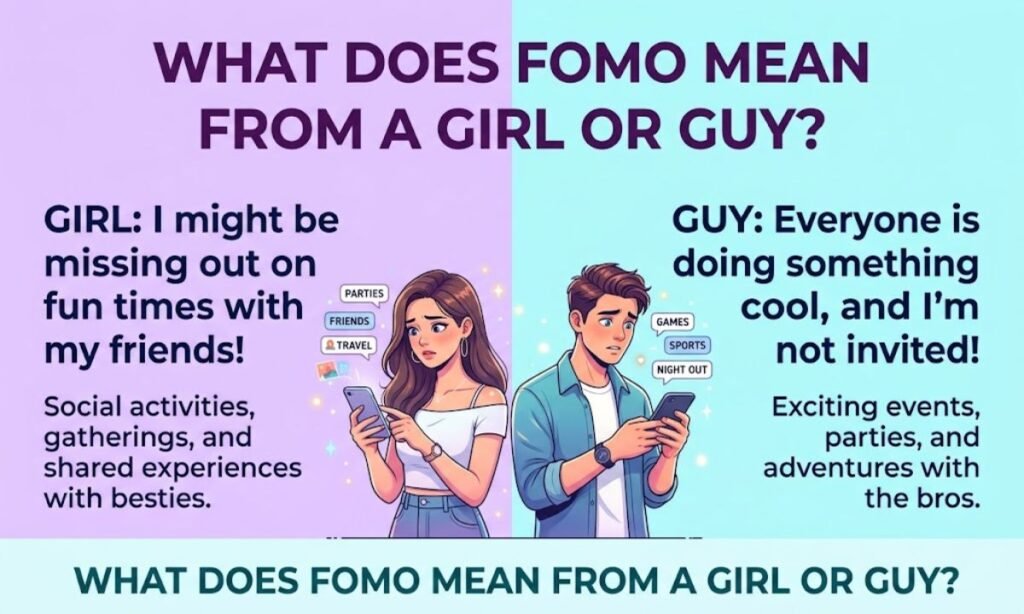
The FOMO meaning in text doesn’t change by gender. A girl or a guy who writes “I have FOMO” feels left out or wants to join. The sender’s gender doesn’t add a hidden meaning.
What matters is the relationship and the tone. A close friend probably means it playfully. Someone you’re dating may be hinting that they’d like an invite.
Quick reading guide:
- FOMO from a girl: usually playful or a gentle hint to include her
- FOMO from a guy: usually the same, often with humor or an emoji
- FOMO from a crush: possibly interest, so watch the rest of the message
FOMO Meaning on Social Media
The FOMO meaning in text on social media is a reaction to what others post. You see a concert, a trip, or a party, and you comment “FOMO.” It’s part praise, part jealousy, part joke.
On social media, it can also describe pressure. People feel they should check apps constantly, so they don’t miss news or online trends. That pressure is why FOMO and social media are so closely linked.
Meaning in Chat
In chat, the FOMO meaning in text is usually the plain definition. “You’re going without me? FOMO 😭” means “I feel left out.” It’s a mild, human reaction.
Sometimes it means the opposite of left out. “I wasn’t going to go, but now I have FOMO” means curiosity turned into interest. Context tells you which one it is.
Examples of FOMO text message examples:
- “Brunch at noon? I have FOMO, save me a seat.”
- “Everyone’s talking about that finale. FOMO is real.”
- “You ate pizza without me? Rude. FOMO!”
WhatsApp, Instagram, TikTok
On WhatsApp, FOMO shows up in group conversations. “Are you meeting tonight? I don’t want FOMO.” It’s often a nudge to be included.
On Instagram, it follows photos and Instagram Stories. “Your trip looks amazing. Total FOMO!” On TikTok, it ties to viral trends and online challenges. “Everyone’s trying this. Now I have FOMO.” Snapchat works the same way, often through streaks and Snap Maps.
FOMO With Emojis
Emojis tell you the mood. Without them, a short “FOMO” can feel flat. With them, the message becomes clear.
Here’s how to read them:
- FOMO 😭 means dramatic or real sadness about missing out
- FOMO 😂 means it’s a joke
- Major FOMO 😩 means a strong feeling of being left out
- No FOMO 😎 means I’m happy where I am
- FOMO 👀 means I’m curious and watching closely
Meaning in Physics, Medical, and Aircraft Terminology
Abbreviations can mean different things in different fields. FOMO is mainly known as Fear of Missing Out. That’s the FOMO meaning in text almost everyone expects.
Still, it’s smart to be careful in technical documents. Specialized fields define their own abbreviations. Always check the source before assuming.
FOMO in Physics
FOMO isn’t a standard physics term with a famous definition. If you see it in a paper or lecture, the author likely defined it for that document.
So look for a glossary or a first-use definition. Don’t force the social meaning into a science setting.
FOMO in Medical Contexts
In health and psychology talks, FOMO refers to the same Fear of Missing Out. People link it to social anxiety, comparison, and emotional well-being.
But FOMO isn’t a diagnosis on its own. Saying “I have FOMO” in a chat doesn’t mean you have a disorder. If worry about missing out affects your sleep, mood, or daily life, talk to a qualified professional.
FOMO in Aircraft Terminology
There’s no single, universal aviation meaning of FOMO. Aviation manuals use many specialized abbreviations that vary by company and system.
If you meet FOMO in an aircraft document, check its abbreviation list. Don’t assume it means Fear of Missing Out.
Common Misconceptions
People often misread FOMO because it sounds dramatic. A few myths show up again and again. Clearing them up makes the FOMO meaning in text easier to use correctly.
Let’s go through the big four.
FOMO Does Not Mean Simple Curiosity
Curiosity says, “I wonder what that’s like.” FOMO says, “Everyone else is experiencing it, and I’m not.”
Compare these two:
- “I’m curious about the new café.”
- “Everyone went to the new café, and now I have FOMO.”
The second one adds the feeling of being left out.
FOMO Does Not Always Mean Serious Anxiety
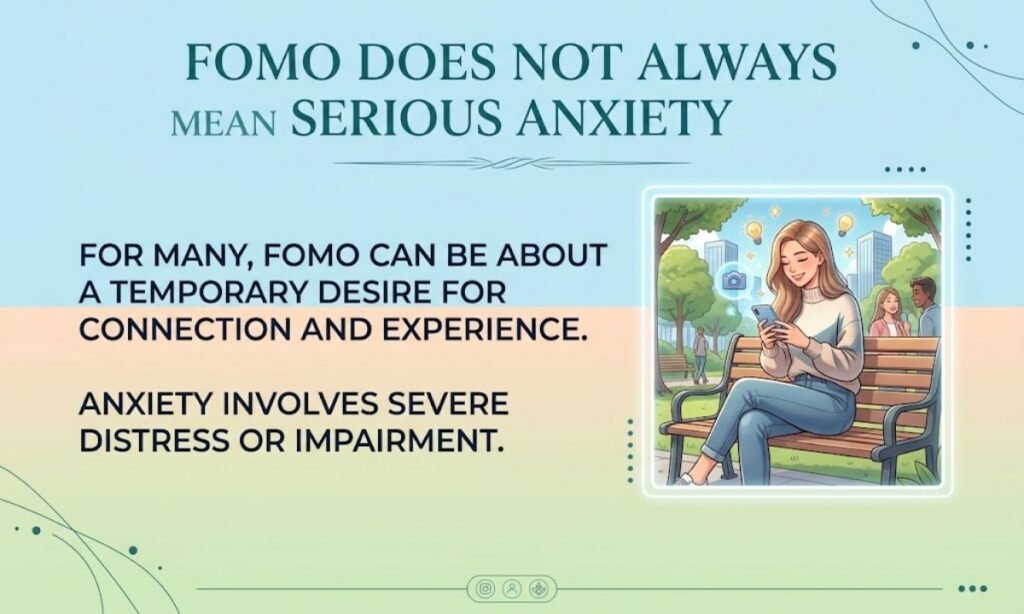
In texts, FOMO is often a joke. “You got ice cream without me? FOMO!” isn’t a cry for help.
Of course, it can be serious for some people. Anxiety about missing out is real, so read the tone before you decide.
FOMO Is Not Limited to Parties
FOMO covers far more than parties. It can attach to almost anything people value.
Common areas include:
- Travel experiences and weekend trips
- Concerts and sports events
- Shopping drops and sales
- Career moves and job openings
- Investments and online trends
- New tech and gadgets
FOMO Does Not Mean Everyone Else Is Actually Having Fun
This one matters most. A perfect photo doesn’t prove a perfect night. People edit, crop, and skip the dull parts.
Remember that the next time you feel left out of an event. The party you’re envying may have been mediocre.
Similar Terms & Alternatives
Several phrases sit close to FOMO. Each one has a slightly different flavor. Knowing the gaps helps you use the FOMO meaning in text with confidence.
Here are the main ones.
JOMO
JOMO means Joy of Missing Out. It’s the happy opposite of FOMO. You skip the event and feel great about it.
Example: “Everyone’s at the bar. I’m home with tea. JOMO!” So when people ask about FOMO vs. JOMO, the answer is worry versus contentment.
Fear of Being Left Out
This phrase is nearly the same as FOMO. It just doesn’t use the abbreviation. It’s clearer in formal writing.
Feeling Excluded
This focuses on the result. You didn’t just fear missing out, you actually got left out. It’s about social exclusion.
Regret
Regret looks backward. “I regret skipping the trip.” FOMO can happen before or during the event, when you’re still deciding.
Curiosity
Curiosity is wanting to know. FOMO adds the sting of possible absence.
How to Respond to It
Your reply depends on the tone of the message. First, decide whether it’s playful or sincere. Then answer in kind.
When someone writes “I have FOMO,” a good reply is warm and short. Here’s how to respond to FOMO in a text:
- Playful: “Ha, your FOMO is showing!”
- Inviting: “Come join us, we’ll save you a seat.”
- Supportive: “We missed you. Next time for sure.”
- Reassuring: “Honestly, it was kind of boring.”
If Someone Says “FOMO Made Me Go”
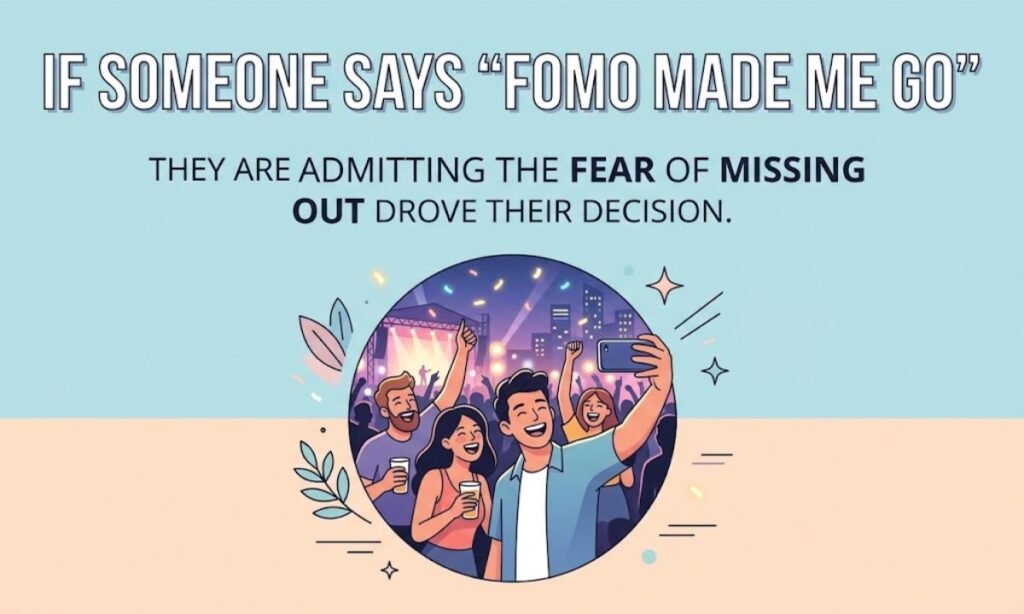
That means they weren’t planning to join. Then the fear of missing the experience changed their mind. It’s the positive side of the FOMO meaning in text.
You could reply, “Glad you came!” or “Was it worth it?” Both keep the chat friendly.
If You Want to Use FOMO Yourself
Using FOMO is easy. Keep it casual, and pair it with context.
Natural examples:
- “I’m getting FOMO just watching this.”
- “I went purely out of FOMO.”
- “This is giving me major FOMO.”
- “Don’t post pictures. You’ll give me FOMO.”
Differences From Similar Words
Many emotions look alike but come from different places. This table makes the gaps clear.
| Term | Basic meaning | Example |
| FOMO | Fear of missing an experience | “I have FOMO about the party.” |
| JOMO | Joy in missing out | “I’m enjoying JOMO tonight.” |
| Curiosity | Wanting to know something | “I’m curious about the event.” |
| Regret | Sadness about a past choice | “I regret missing it.” |
| Envy | Wanting what others have | “I’m envious of her trip.” |
| Jealousy | Fear of losing attention or love | “He felt jealous when she chatted with someone else.” |
The key is the cause. FOMO is about not wanting to miss an experience. Envy is about wanting something someone owns.
Relevance in Online Conversations & Dating Apps
Online talk makes FOMO louder. Everyone’s plans are one tap away. That’s why FOMO in online conversations is now a daily topic.
On dating apps, it shows up in a special way. People keep swiping because a better match might be next. They hesitate to commit, and that’s FOMO in action.
FOMO and Social Media
Scrolling is the biggest FOMO machine. You jump from one social media post to another and see endless fun. It’s easy to feel behind.
A few habits that help:
- Set app time limits.
- Mute accounts that make you feel small.
- Unfollow stress triggers.
- Plan one real activity each week.
FOMO and Online Decision-Making
FOMO also drives online purchases. People buy because “everyone has it.” That’s fear of making the wrong decision, mixed with peer pressure.
Before you buy, ask three questions:
- Would I want this without the hype?
- Can I afford it comfortably?
- Will I still care next week?
If you answer no, skip it. That’s a quiet win over FOMO.
Real FOMO Examples in Text Messages
Seeing real lines helps the FOMO meaning in text click. Below are FOMO examples in sentences you can borrow or recognize.
- “Everyone’s at the lake. FOMO!”
- “I stayed home and now I have serious FOMO.”
- “That playlist drop? Total FOMO.”
- “Don’t tell me the plot. I’m getting FOMO.”
- “FOMO is real when the whole office is out.”
Also read meanings on HYD Meaning in Text: The Surprising Truth Behind This Popular Slang in 2026
How to Handle FOMO Without Letting It Run Your Day
A little FOMO is normal. A lot can drain you. The fix is mostly about attention and choices.
Try these steps:
- Name it. Say, “This is FOMO,” and it loses power.
- Check your values. Do you actually want that event?
- Limit scrolling. Less input means less comparison.
- Practice JOMO. Enjoy a quiet night on purpose.
- Talk to someone. A friend can help you see it clearly.
If it keeps bothering you, consider talking to a counselor. That’s a smart step, not a weakness.
FOMO Meaning in Text in 2026: What’s Different Now?
In 2026, the FOMO meaning in text is the same, but the setting has shifted. Short video, live features, and group chats make the feeling faster than ever. Recommendation feeds also push trends harder.
People now talk more openly about digital balance. Terms like JOMO and “digital detox” appear in casual chats. So the slang has grown from a complaint into a conversation about emotional well-being.
Should You Use FOMO in Everyday Conversations?
Yes, in casual settings it’s perfectly fine. Texts, captions, and chats with friends are ideal places. It’s one of the most recognized internet slang terms.
In formal emails or reports, write “fear of missing out” instead. Not everyone knows the abbreviation. Knowing your audience keeps the FOMO meaning in text clear and professional.
Conclusion
Now you know the real FOMO Meaning in Text. It stands for “fear of missing out.” People use it when they feel left out of fun plans. It shows up in chats, captions, and comments every day. The word is short, but the feeling is big. Once you get it, you will spot it everywhere.
The FOMO Meaning in Text is easy to use in your own chats. Say it when you wish you were at the party. Say it when your friends post fun trips. Just keep it light and use it with the right people. Slang keeps changing, but this one is here to stay in 2026.
FAQs
What is FOMO in Gen Z slang?
FOMO stands for “Fear of Missing Out.” Gen Z uses it to describe the anxious feeling of being left out of fun events, trends, or experiences others are enjoying.
What does FOMO mean from a girl?
When a girl says FOMO, she usually means she feels left out or worried she’s missing something exciting, like a party, trip, or hangout. It can also be a hint that she wants to be invited or included.
What is FOMO in social media?
On social media, FOMO is the uneasy feeling that comes from seeing others’ posts, trips, and highlights, making you feel your own life is less exciting or that you’re missing out.
What Does FOMO Mean in Text?
FOMO means “fear of missing out.” It is the worry that others are having fun or doing something great without you.
What Does FOMO Stand For?
FOMO stands for “fear of missing out.” People use it when they feel left out of a trip, party, or trend.
How Do You Use FOMO in a Text?
You use it to say you feel left out. For example: “Seeing your beach pics is giving me major FOMO.”
Is FOMO a Good or Bad Thing?
FOMO is a normal feeling, but too much of it can cause stress and anxiety. In texts, it is often used in a light, joking way.
What Is the Opposite of FOMO?
The opposite of FOMO is JOMO, which means “joy of missing out.” It is the happy feeling of skipping plans and staying in.

I am a passionate writer with over 3 years of experience creating funny, clever, and engaging pun content for readers of all ages. I enjoy turning everyday ideas into witty wordplay that makes people smile and laugh. My goal is to deliver fresh, creative, and high-quality puns that brighten your day with every visit.